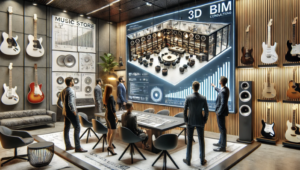
Running a music store is not just retail. It is a place where people come to discover new sounds, test gear, learn, connect, and sometimes perform. That means your building has to work harder than a typical storefront. It needs excellent acoustics, smart layout flow, flexible rooms, reliable power, clean air, safe egress, and a customer experience that feels effortless even on a busy Saturday.
BIM Consulting, short for Building Information Modeling consulting, helps music store owners plan, design, build, renovate, and operate spaces with fewer surprises and better outcomes. It brings the entire project into a coordinated 3D model that connects architecture, structure, mechanical systems, electrical, lighting, fire protection, technology, and even your merchandise strategy. The result is a store that sounds right, runs efficiently, and stays adaptable as the music business keeps changing. 🎸
A Music Store Is an Acoustic Environment, Not Just a Room With Shelves 🔊
Sound is the product and the atmosphere. A music store needs controlled noise, clear demos, and zones that do not bleed into each other. Drum kits, amps, PA speakers, and acoustic instruments all behave differently in the same space. BIM Consulting supports acoustic planning by coordinating room shapes, ceiling heights, wall assemblies, doors, glazing, and insulation so the store does not turn into a constant echo chamber.
With BIM, acoustic intent becomes part of the coordinated model instead of an afterthought. Demo rooms can be designed with realistic dimensions and proper isolation. Shared walls can be built correctly the first time. Mechanical penetrations get coordinated early so you do not accidentally punch holes through your best soundproofing later. That coordination is where money is saved and headaches get avoided. 🎧
MEP Coordination Prevents the Hidden Problems That Hurt Sales 💡
Music stores rely on electrical loads that surprise general retail designers. Amp walls, pedal displays, keyboard stations, recording interfaces, digital signage, charging points, lighting tracks, security systems, and network equipment stack up fast. Add in HVAC needs for comfort and humidity control, and the ceiling becomes crowded.
BIM Consulting helps coordinate MEP systems so power, data, lighting, ductwork, sprinkler lines, and speakers do not fight for the same space. This matters because conflicts in the field cost time and force compromises. In a music store, compromises show up as ugly surface-mounted conduit, noisy air vents above demo areas, poorly aimed lighting that makes products look dull, and dead zones where your POS or Wi-Fi acts up.
BIM coordination also supports cleaner installs for specialty areas like recording booths, lesson studios, repair benches, and small performance corners. When the model is coordinated, contractors are not guessing, and you are not paying for rework. ✅
Better Layout Decisions Before Construction Starts 🧭
The way customers move through your store affects how long they stay and what they buy. Instrument zones, accessory impulse sections, lesson traffic, repair drop-off, and checkout placement all influence revenue. BIM allows you to visualize the store at human scale before anything is built. You can see sightlines, aisle widths, queue locations, and how sound and crowds might interact.
This is especially valuable during renovations, when you are trying to keep parts of the store open. BIM Consulting can support phased plans and clear construction sequencing so the project stays safer and less disruptive. It also helps your team plan merchandising resets with confidence because dimensions are known and consistent. 🎹
Renovations and Tenant Improvements Get Safer and Faster 🛠️
Many music stores operate in older retail shells where surprises are common. Hidden beams, uneven slabs, legacy wiring, unknown duct runs, and outdated fire protection can derail a schedule. BIM Consulting helps reduce the unknowns by mapping existing conditions into a model, then using that model to plan the work precisely.
If you are adding a lesson wing, converting storage to a repair shop, creating a boutique vinyl room, or building a small stage, BIM makes sure every trade is aligned. It also helps produce clearer documentation for permits and inspections, reducing delays that keep you from opening on time.
When timelines matter, BIM supports better planning and fewer site conflicts. That means less downtime, fewer change orders, and a more predictable path to reopening or expanding. ⏱️
Inventory, Fixtures, and Custom Displays Fit Right the First Time 🎛️
Music retail often uses custom displays, hanging instrument walls, slatwall, lockable glass cases, pedal demo stations, and branded feature tables. If dimensions are off by even an inch, it becomes an expensive scramble. BIM Consulting supports accurate dimensions, clash checks, and coordination with millwork and fixture vendors.
This is not just about aesthetics. Proper mounting locations, backing support, power placement, and lighting angles impact safety and product presentation. A well-modeled display wall reduces the risk of damage, theft exposure, and awkward customer interactions. It also improves how premium gear is showcased, which directly influences close rates.
Operations Improve After the Project, Not Just During It 🧾
A BIM model can become a useful operations tool once the build is complete. Instead of relying on scattered paper plans, you can keep a digital reference for where equipment is located, what filters a unit needs, where shutoffs are, what ceiling zones hide critical cabling, and how systems are connected.
For a music store, that can mean faster troubleshooting when a demo room is too hot, when an audio circuit trips, when a humidity control unit needs service, or when a new display needs power. Over time, that reduces operational friction and keeps the customer experience consistent. 📌
Technology and Omnichannel Demands Are Easier to Support 📲
Modern music stores are part showroom, part education hub, part content studio, and part shipping operation. Many stores now do live product demos, social content, local artist events, online order fulfillment, and service scheduling. BIM Consulting supports the infrastructure behind that reality: network layouts, camera and lighting provisions, acoustic zones, storage planning, loading coordination, and the power and data needs for future growth.
When your space is designed around adaptability, you are not forced into messy retrofits every time your business adds a new revenue stream. That flexibility is a real competitive edge. 🚀
Staying Connected to Music News Helps Your Space Keep Up 🎼
The music industry shifts constantly, and those shifts influence what sells, how customers shop, and what experiences they expect in-store. Keeping an eye on music news outlets helps store owners plan smarter expansions and merchandising strategies, especially when new formats, touring trends, or technology shifts change demand. Reliable places to track what is shaping the business include Billboard Music News, Rolling Stone Music News, Pitchfork News, Music Business Worldwide, and Variety Music News. Broader context on the business side of music is also easy to reference through Wikipedia’s Music Industry overview. 🎺
BIM Consulting aligns with that same mindset because it helps your physical space respond to change with less cost and less disruption.
Conclusion 🎵
A music store succeeds when it feels good to be inside it. The sound is controlled, the gear is easy to explore, the staff can teach and demo without chaos, and the building supports the business instead of fighting it. BIM Consulting makes that possible by coordinating every system and trade before construction starts, reducing costly surprises, and helping you build a store that is ready for the next chapter of music retail.
When your space is designed with intention and coordinated with BIM, you get more than a nicer build. You get a smoother operation, a better customer experience, and a physical storefront that can grow along with your brand. 🎸